Five months traveling and three workshops, without the opportunity to restock, means a fair amount of paint, brushes and paper must be carried. I like to get as much done as possible in the workshops, so we usually complete 2-3 small paintings each day. At that pace the workshops alone will use up around 40 quarter sheets. Fortunately I only use a few colors (Indian Yellow/ Quinacridone Gold, Permanent Alizarin Crimson, Burnt Sienna, French Ultramarine Blue and Phthalo Blue) Half a dozen tubes of each of these plus a handful of other less used colors, Ink, Gesso, Gouache, a pile of brushes and pencils and things soon start to look like a mobile art supply store.

Watercolors, Gouache, Acrylics, Gesso, Ink, Lightweight Easel, Folding Palette, Pastel Pencils, Black and White Charcoal Pencils, Derwent Inktense Pencils, One stroke Brushes, Liner Brushes, Hake Brushes, Old Bristle Brushes, Water Container and Towel
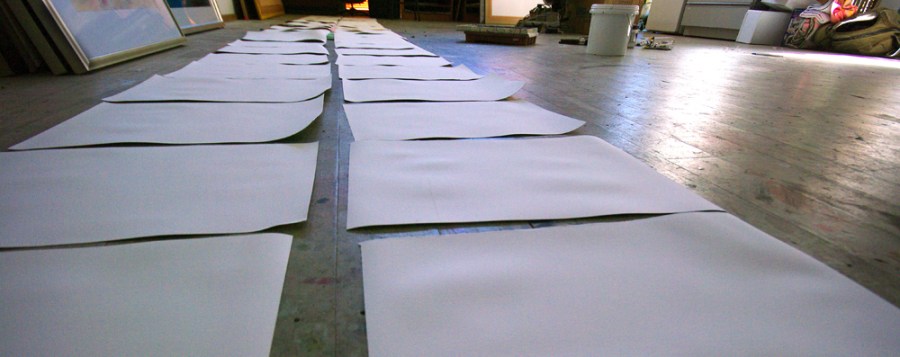
Fifty sheets of Arches 300gsm cold pressed paper – cut, soaked, flattened and drying on the studio floor.

Transporting watercolor paper over corrugated dirt roads can have disastrous results. Constant vibrations wear through the top surface of the sheets making them useless. Clamping the paper between two sheets of core board stops them moving against one another.
Finished paintings are clamped in the same way to keep them from damage.
WORKSHOP MATERIALS LIST
For people attending workshops, here is a list of materials I use most of the time and the brands I prefer.
PAINT
- *Ultramarine Blue (Art Spectrum )
- *Phthalo Blue ( Art Spectrum )
- *Alizarin Crimson (W & N or Rowney)
- Burnt Sienna (Rowney or Art Spectrum )
- *Indian Yellow ( Rowney is the only real transparent one capable of mixing rich darks) or
- *Quinacridone Gold (Windsor & Newton) This is more permanent than Indian Yellow but a little less intense
- *White Gouache
- Small container of Gesso
Used less frequently : Cobalt Blue, Indigo, Rose Madder
*These are the most important colours.
INK
- Burnt Siena pigmant ink (Art Spectrum)
- Plain dip in pen and nib
BRUSHES
- 1 inch flat Taklon (One Stroke)
- 1/4 inch flat Taklon (One Stroke)
- #2 Taklon liner
Neef are a good brand of taklon brush
- An old 1/2” bristle house painting brush is also a handy thing to have.
- 2” or 3” Hake brush or wide soft goat hair brush
OLD TOWEL
Handy for adjusting the amount of water in your brush.
PALETTE
The best palette is one with a fair amount of room for mixing and a slopingside on the paint wells. This allows dirty paint to run to the bottom of thewell keeping the fresh paint reasonably clean. For traveling, a small folding palette is best
PASTELS
A mixture of hard and soft pastels, Schwan Stabillo, or conte, pastel pencils and charcoal pencils.
WATER SPRAY BOTTLE
PAPER
I prefer Arches paper, but also like Saunders rough and Cottman (a cheap, heavily sized paper) for quick water colour sketches and demos





 Splashing Paint