BACK IN THE STUDIO

After 5 months away it’s good to get back in the studio and start painting. As much as I enjoy painting outdoors, I always feel the best work comes when conditions are under control and there is limitless time to consider things

.

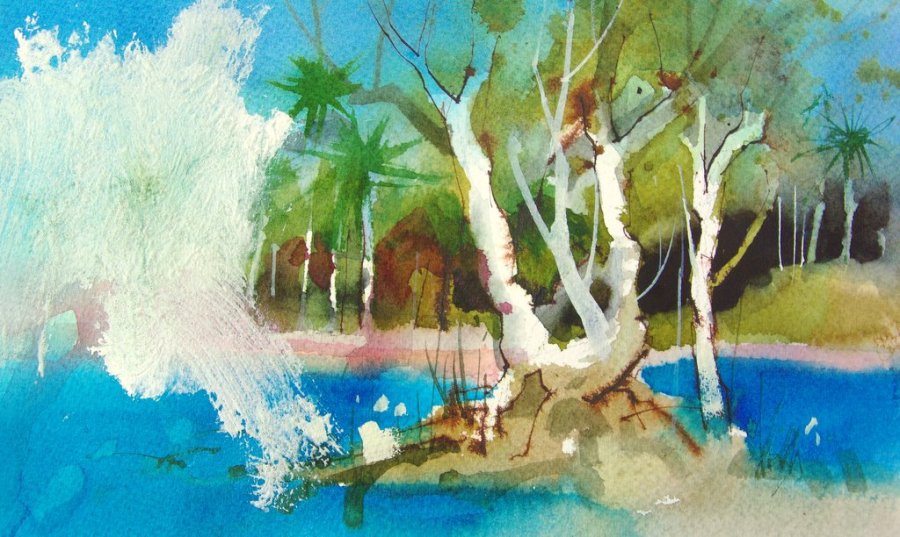
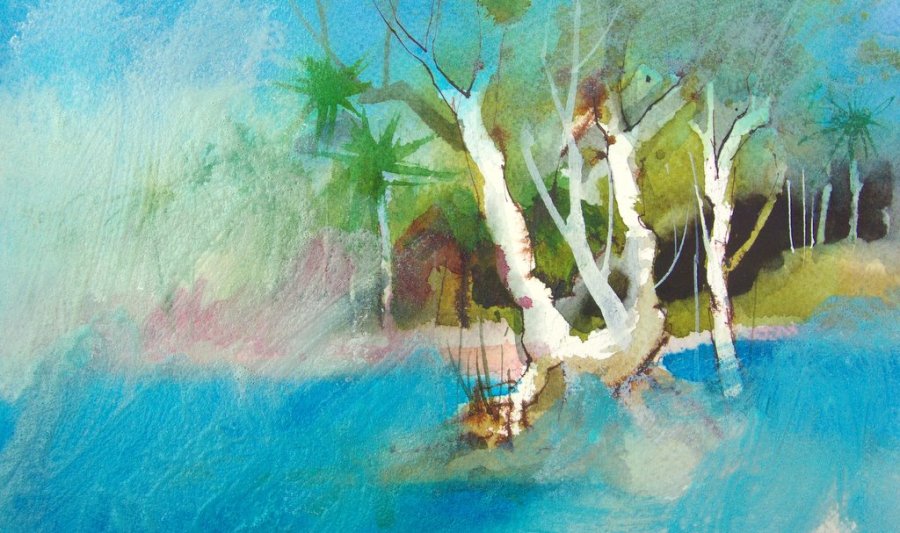
The first thing I did when I got back to the studio was pull out the last demonstration painting I did at the workshop in Pemberton. At the time I was wrestling with it and hurrying to get it finished. I just wanted to see where it would go with a little more time and less pressure.

I attacked it with a 1″ house painting brush full of gesso , leaving the central core of previously painted watercolor untouched. After the gesso dried, detail was added and blotted back with tissue.

The pigment sits on the surface of the gesso, so can be sprayed and blotted back similar to yupo paper. This produces the subtle effects seen in the detail above. It is an interesting, very controllable way to work and produces unusual results.

ARNHEM LAND REFLECTIONS

WATERCOLOR AND MIXED MEDIA PAINTING DEMONSTRATION

Throughout Kakadu National Park, the landscape is dominated by the Arnhem land and Kakadu escarpments. In their own  right, these bands of ancient sandstone are spectacular sights. Seen across the wetlands and  through curtains of paperbark trees, the escarpments add a rich, warm shot of colour to a fairly monochrome landscape.

In this painting I want to use a sickly pink acrylic pigment to exaggerate the warm hues of the escarpment. To really give this colour some impact I will contrast it with some raw Ultramarine Blue

IMGP5808

The spectacular Kakadu escarpment

The range of colours for this painting is very small. Medium Magenta Acrylic being the only unusual pigment.

materials

On the extreme left, above, is a small water spray. Not in the image is a 3″ Hake brush
IMG_4691

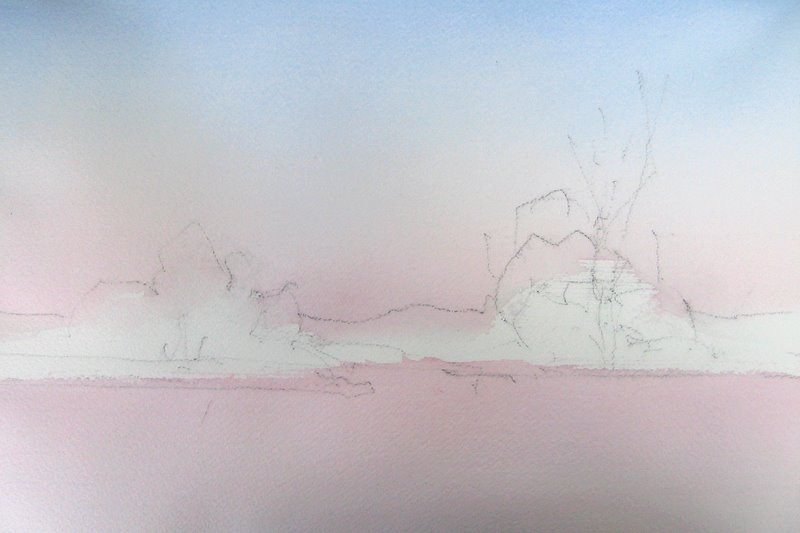
A rough sketch sketch provides just enough information to place the various elements. The first washes are gradations of Ultramarine Blue and Alizarin Crimson.

IMG_4692

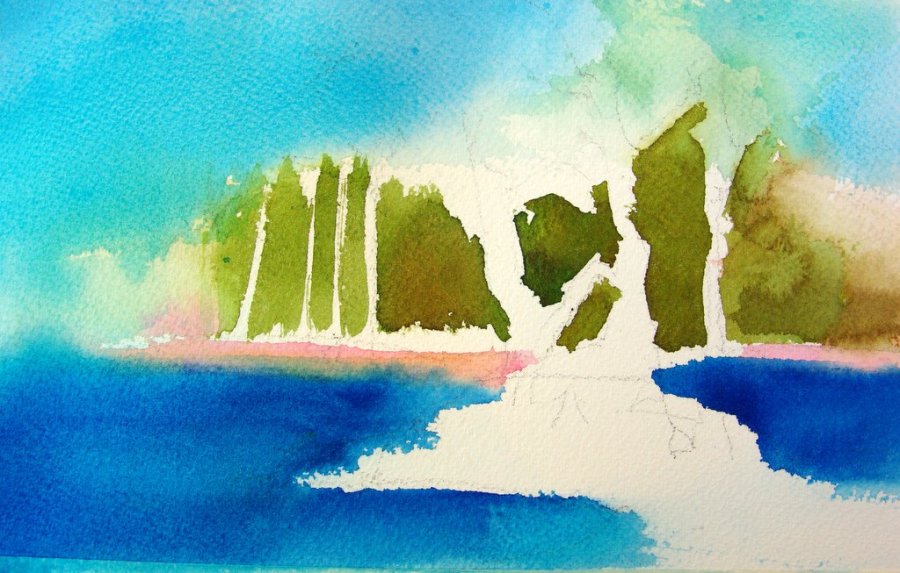
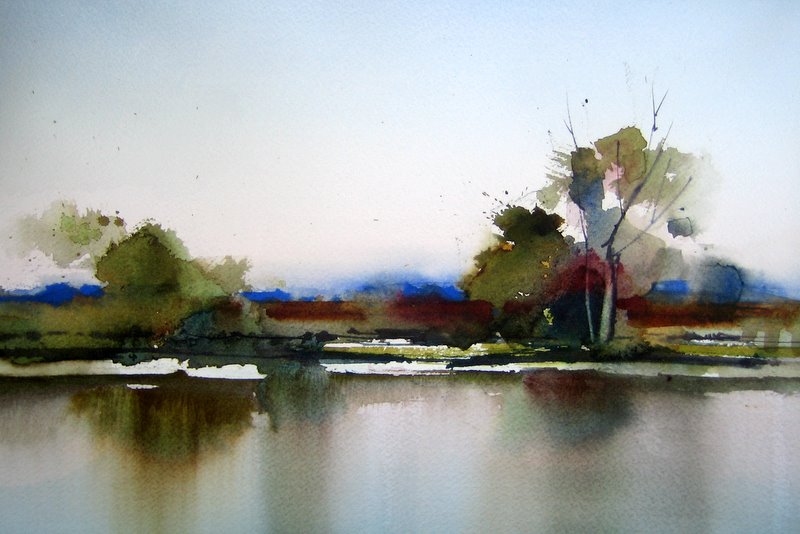
Once the first washes are completely dry, the foliage can be suggested with varying mixtures of Quinacridone Gold, Alizarin and Phthalo Blue. In order to make the shapes appear random and uncontrived, the paint is splashed onto the paper then the edges are adjusted before the pigment dries.  The important thing to remember with these shapes is to put as much variation as possible into the edges.

The horizontal bands of white paper will later be tinted to represent the horizontal line of the waters edge.
IMG_4694

More detail is added to the foliage and reflections. The pure Ultramarine that will form the shadow at the bottom of the escarpment is dropped in and softened with a damp 1″ brush

A liner brush is used to add the fine twigs and branches. The paler, main tree trunks, are lifted out with a damp 1″ flat brush.

IMG_4695

Finally the sickly pink acrylic is dropped in over a wash of Quinacridone Gold and Alizarin Crimson. A wash of Phthalo Blue cools down the water. Graded washes of Ultramarine Blue darken the outer edges of sky and water.

With the painting once again , thoroughly dry, pools of White Gouache are dropped into the sky and water and adjusted with a dry hake brush and water spray.

The last step is to add some Burnt Sienna Ink marks and Black and White charcoal pencil lines to suggest  finerl detail.

WATERCOLOR WINDMILL

batchelor map

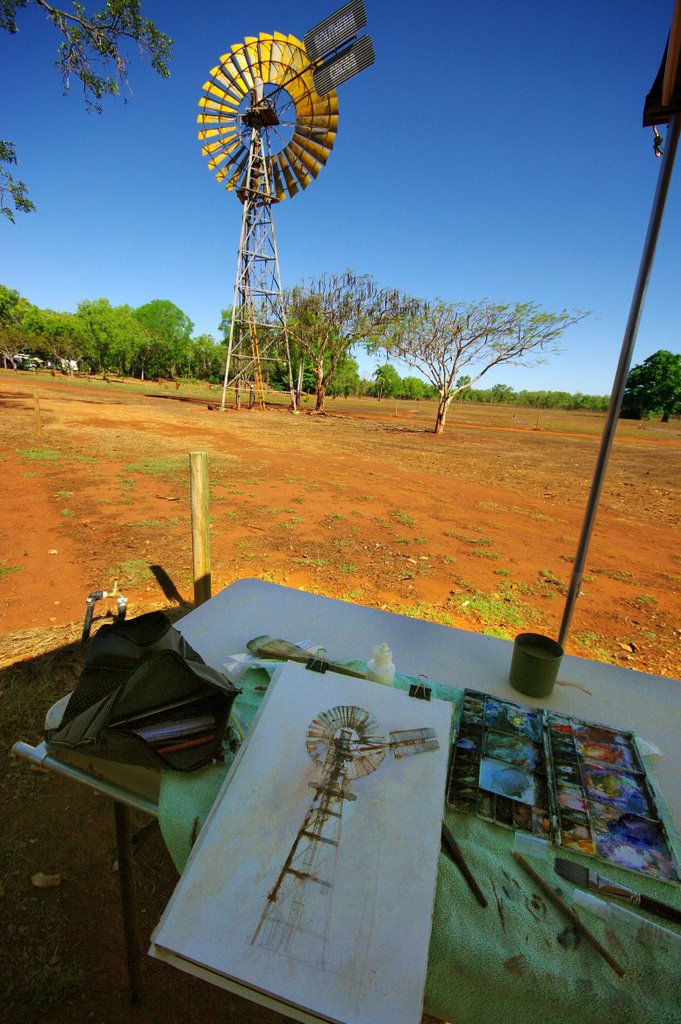
Outside the town of Batchelor, we camped under a huge old Southern Cross windmill. The kind that turn and creak at the slightest breath of wind.

IMGP5323x

I started to sketch it but every time I looked up the wind had changed and it looked completely different. I decided to ignore what it looked like from where I sat and draw it square on from in front.

Once it had shifted around a few times I had enough information to disregard perspective and make the drawing flat and mechanical.

IMGP5324

The initial drawing was done with Charcoal pencil, then washes of indigo and Burnt Sienna were put in fairly loosley with a 1″ and 1/4″ flat brush. The windmill was old and coated with rust and grease. I wanted the sketch to give the impression of reliability while indicating the wear and tear of a hard life.

Burnt Sienna ink lines were added then the drawing was broken up slightly with washes and splashes of White  Gouache.

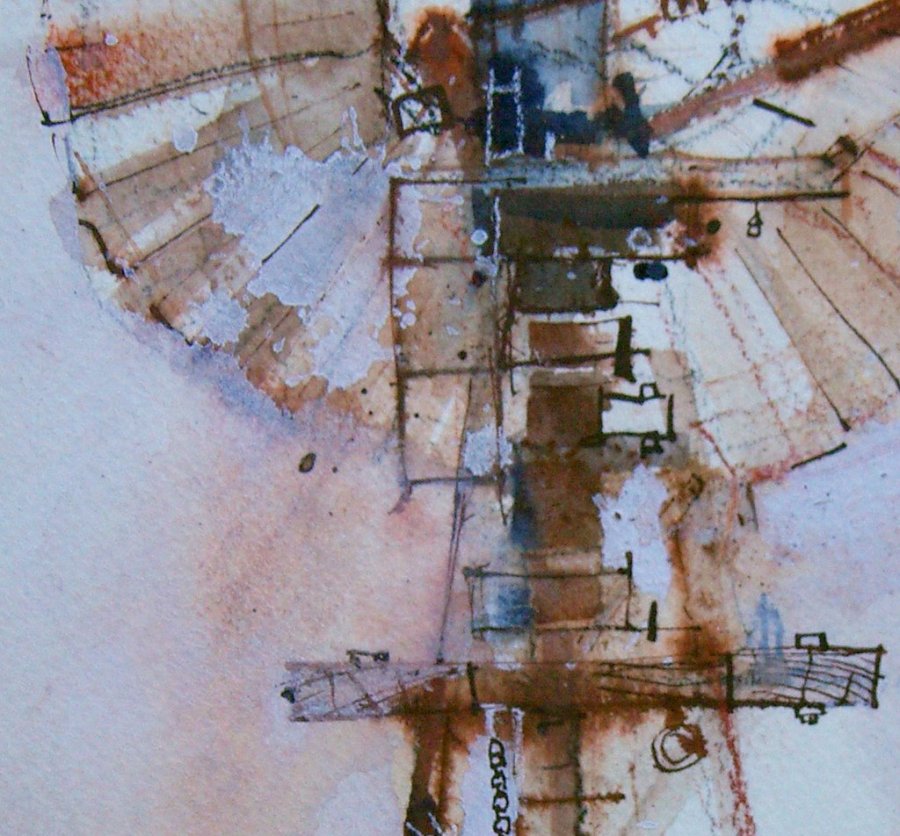
windmill detail

This detail shows the Burnt Sienna ink lines, some left hard and sharp, others sprayed and softened with a mist of water. You can also see lines of white charcoal pencil adding to the detail and loose splashes of White Gouache.

These mechanical subjects are a lot of fun to paint. You can fill them with atmosphere and character, saying more about their life and function than their actual appearance.

RIVER PAPERBARKS – KATHERINE

PAINTING DEMONSTRATION

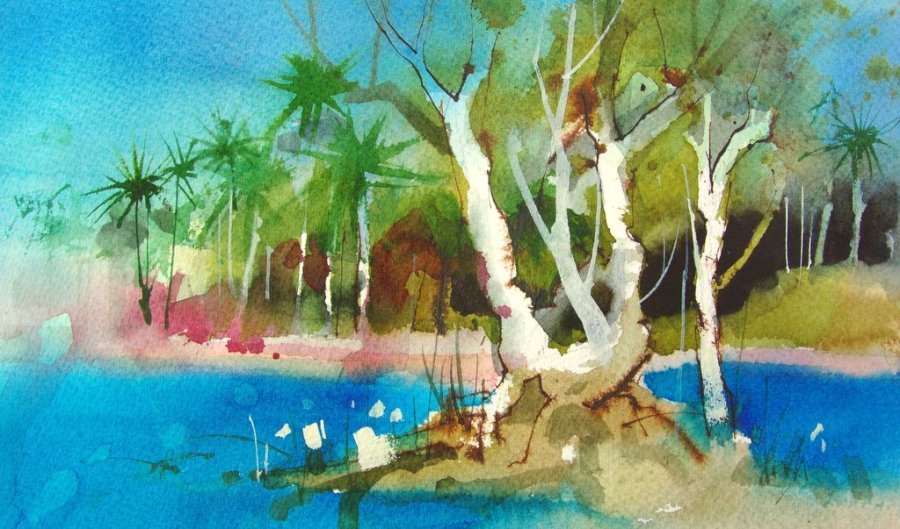
The big, distorted paperbarks along Katherine River are awesome things. They defy the battering dished out by the annual wet season, accumulating scars and debris, to emerge each dry with an invincible appearance that defines the rivers character.

IMGP5089

This painting started with a simple charcoal sketch

.

.

IMGP5092

The first washes were cut in around the tree shapes with a  a dirty green mixed from Quinacridone Gold, Phthalo Blue and Alizarin Crimson. Some Phthalo Blue was dropped into the sky and a pale Alizarin dragged along the river bank.

.

.

IMGP5094

A strong  Phthalo Blue was washed into the water then diluted slightly for the sky. These areas are more intense than I want, as I plan to knock them back with a glaze of Gesso.

.

.

IMGP5097

The next step was to put a contrasting band of dark behind the main trees. More detail was added to the trees and foliage, then a few rough ink lines were scratched in. Splashes of pure Alizarin were dropped into the area I plan to soften with the Gesso glaze

.

.

IMGP5099

Before the colours were completely dry Gesso, straight out of the pot, was worked over the distant bank with a 1/2″ bristle brush.

.

.

IMGP5100

The Gesso was quickly spread and thinned with water.

.

.

IMGP5101

While everything was still wet a 3″ Hake brush was used to smooth the Gesso into a soft, transparent haze. This was done quickly and lightly, keeping the brush very dry with an old towel.

.

.

IMGP5102

With the painting still wet, patches of tinted white Gouache were put on and softened with a fine spray of water.

.

.

IMGP5103

The final step was to add more detail and definition with ink, white charcoal pencil  and rigger lines

MATERIALS

Phthalo Blue

Ultramarine Blue

Permanent Alizarin Crimson

Quinacridone Gold

Burnt Sienna Ink

White Gouache

Gesso

Black and White charcoal pencils

1/2″ bristle brush

1″ and 1/4″ flat taklon one stroke

#2 liner

3″ Hake